
Why Most Traps Go on the Wrong Tunnels
The number-one reason DIY mole trapping fails isn't the trap — it's the tunnel. A typical Post Falls lawn shows a maze of raised ridges, and the instinct is to put traps on the most obvious ones. But those twisty surface ridges are feeding runs: shallow, used once or twice, then abandoned. Setting a trap there is like setting a mousetrap in a room the mouse visited last Tuesday.
The tunnels that matter are the permanent runways — deeper (three to twelve inches down), straighter, and traveled two or three times daily as the mole commutes between feeding areas. You can't see them from the surface the way you see feeding ridges. You have to test for them. The good news: the test is simple, free, and takes 24 hours.
The Stomp-and-Check Method, Step by Step
Step 1: Pick your candidates. Walk the yard and identify five to eight straight-ish ridge sections, each about two to three inches long. Prioritize runs along hard edges — driveways, sidewalks, foundation lines, fence rows. Moles use these as navigational highways, and they're consistently the highest-percentage trap locations. Include a couple of the twisty ones too, for comparison.
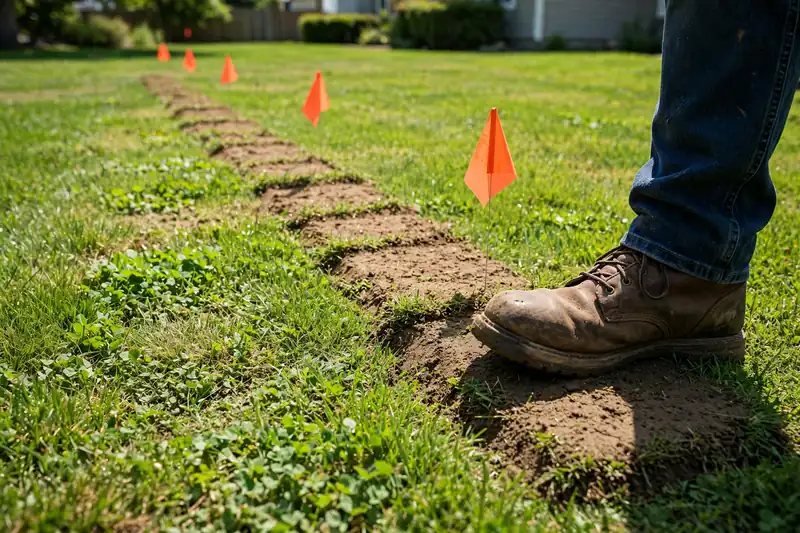
Step 2: Flatten and mark. Step firmly on each section to collapse it flat — you're erasing the ridge. Mark each spot with a small flag, stick, or even a pinch of flour. You need to find these exact spots again tomorrow, so don't rely on memory.
Step 3: Wait 24 hours. Don't check early. Moles run their tunnels on roughly four-hour active/rest cycles, so a full day covers multiple passes. If it rains heavily overnight, the test still works — rain doesn't stop moles — but note it, because heavy rain can flatten ridges on its own and confuse the reading.
Step 4: Read the results. Walk your marked spots. Any section that's been pushed back up — ridge re-formed, soil disturbed — is an active tunnel. That's where traps go. Sections still flat after 24 hours are inactive; skip them. In our experience, roughly a third of marked sections typically show activity — which tells you how much trap effort gets wasted without this test.
Reading the Subtleties
A few things the basic instructions don't tell you. Partial repair counts. If the mole pushed up half the flattened section, that's still active — it just didn't do a thorough job this pass. Straight beats twisty, always. If a straight section and a twisty section both show activity, trap the straight one first; it's the higher-traffic route. Fresh mounds near a run are a bonus signal — active excavation means active tunneling nearby.
The screwdriver probe is the professional's companion technique. Push a long screwdriver into the ground around suspected tunnel areas; when it suddenly sinks with little resistance, you've found a void. It takes practice to distinguish tunnel voids from soft spots, but combined with stomp-and-check it builds a reliable map. Probe along the lines connecting your active sections — you'll often trace the runway's path.
When to test: spring (March–April) and fall (September–October) give the clearest readings in North Idaho, because moles are working near the surface. In dry midsummer, surface activity drops as moles go deeper — the test still works, but fewer sections will show activity. In frozen winter ground, don't bother; wait for the thaw.
What This Tells a Professional
If you do call us, the single most useful thing you can say is "I stomp-tested on Tuesday and these three runs were repaired by Wednesday." That tells us the active network layout before we arrive, which means faster trap placement and fewer wasted sets. Some of our most efficient jobs started with a homeowner who'd done exactly this.
And if the test shows no activity anywhere after 24 hours? That's information too — it might mean the damage is old (spring snowmelt reveals winter tunneling that looks fresh), the mole has moved on, or what you're seeing isn't moles at all. Voles don't repair flattened ridges because they don't make ridges. A completely negative test is worth a second look at the identification before anyone sets a trap.
For the full trapping process once you've found the active runs, see our mole trapping page or the complete mole control sequence — or just call us and we'll take it from the map you've already made.
Questions About This Topic
How long should I wait before checking the flattened tunnels?
24 hours. Moles cycle through roughly four-hour active and rest periods, so a full day covers multiple passes through their runways. Checking sooner risks a false negative — the mole just hasn't come around yet.
What if none of the flattened sections get repaired?
Three possibilities: the damage is old (winter tunneling revealed by spring melt looks fresh but isn't), the mole has moved on, or it's not moles. Voles make surface runways, not raised ridges — if nothing repairs, re-examine the sign before setting any traps.
Can I do this test in winter?
Not usefully in Post Falls. Frozen ground (roughly December through February) means no surface activity to read. Wait for the spring thaw — March and April give the clearest readings of the year.
Do I need special tools?
No. Your boot, something to mark spots with (flags, sticks, flour), and 24 hours of patience. The screwdriver probe technique helps for tracing runways between active sections, but the stomp test alone is enough to place traps effectively.
Need Help With Moles?
Call and describe what you're seeing — we'll talk through the next step.