
MoleGuard — Underground Barriers
Keeping Moles Out — For Good
Trapping removes the moles you have. Exclusion keeps the next ones out. It's the only long-term answer for high-value areas — vegetable gardens, new sod, flower beds — where you can't afford to play whack-a-mole every spring. The principle is simple: moles can't dig through what they can't dig through. The execution has to be right, or you've just built an expensive decoration.
The material is quarter-inch galvanized hardware cloth — not chicken wire (the gaps are too big and it rusts through), not plastic mesh (moles chew or push past it). Real exclusion is a buried wall, and the details matter more than the material.
Keeping Moles Out — For Good: Key Details
- How a proper barrier goes in
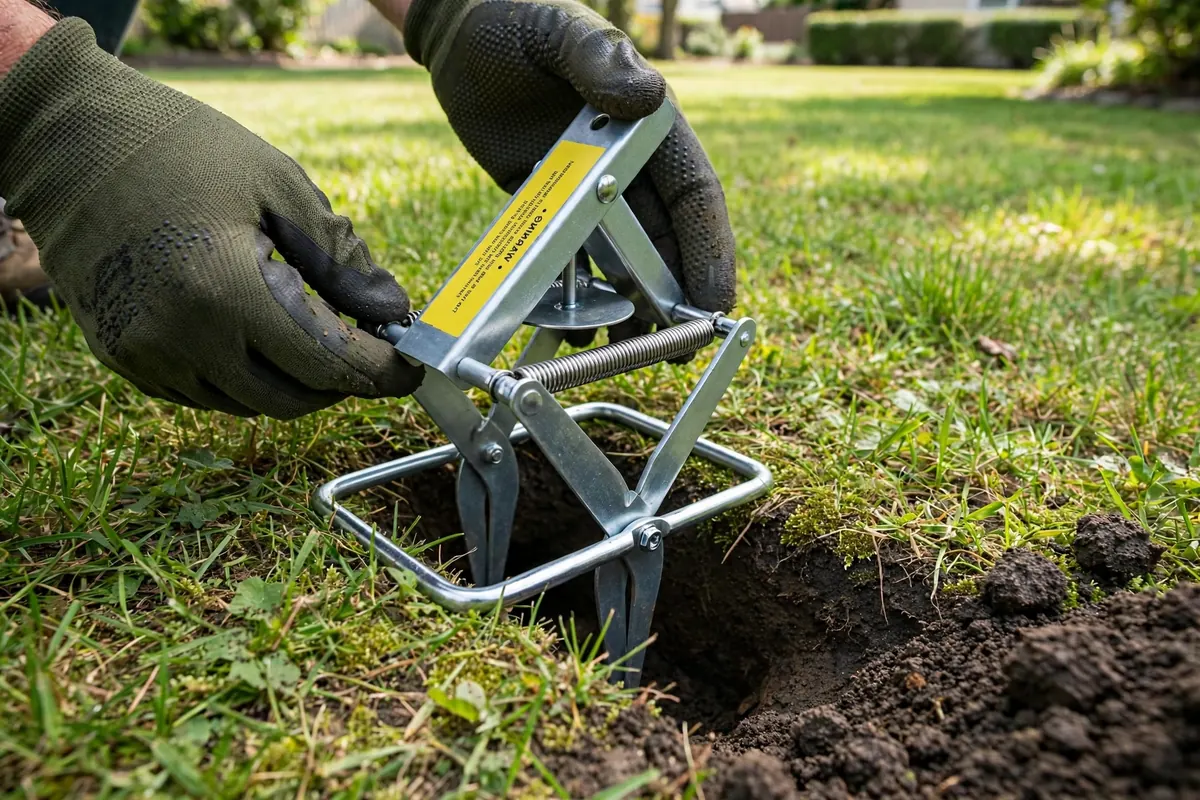
Trench twelve or more inches deep around the area you're protecting. Set the hardware cloth vertically in the trench, then bend the bottom four inches outward at a ninety-degree angle, away from the protected area. That outward foot is the critical detail — when a mole digs down along the barrier and hits the bend, it turns away instead of digging under. Backfill and compact the trench so there are no gaps.
Above ground, the barrier should extend a few inches up — enough to see, not enough to be ugly. For garden beds, six inches above grade is plenty. The whole thing has to be continuous: one gap, one spot where the cloth doesn't quite meet the fence or the foundation, and you've built a very expensive funnel.
- Where exclusion makes sense — and where it doesn't
Exclusion is practical for defined, high-value areas: a vegetable garden, a flower bed, the perimeter of new sod, a putting green. It's not realistic for an entire yard — the trenching, material, and labor for a full property line run into territory that doesn't make sense, especially in Post Falls' rocky glacial soils where every foot of trench is a fight.
There's also a catch most installers won't mention: a barrier only keeps moles out if there are no moles inside when it goes up. Fence a garden with a mole already in residence and you've just built it a private reserve. We always trap first, verify the area is clear, then install the barrier. In that order, every time.
- The new-lawn opportunity
The single best time for exclusion is before the sod goes down. Under-sod mesh — hardware cloth laid flat across the prepared grade before sod or seed — is the legitimate long-term play for new lawns. It's far cheaper to install during construction than to retrofit later, and it protects the most vulnerable phase: fresh sod on disturbed soil is a magnet for moles, and North Prairie and Post Falls East are full of exactly that right now. If you're putting in a new lawn, talk to us before the sod arrives, not after the first mounds appear.
Dealing With Mole Exclusion?
Call MoleGuard — tell us what you're seeing and we'll take it from there.
MoleGuard — Underground Barriers
Exclusion vs. Everything Else
Let's put exclusion in context against the other options, honestly. Trapping removes current moles but doesn't prevent the next ones. Habitat modification — mainly reducing irrigation so the soil dries and worms stay deep — makes the lawn less attractive but won't evict an established mole. Repellents (castor oil and the rest) have, at best, shown weeks of reduced activity in small trials; they don't remove anything.
Exclusion is the only method that physically prevents re-entry. It's also the only one with a significant upfront cost and a limited practical scope. That's not a sales pitch for or against — it's the trade-off, and which side you land on depends on what you're protecting and how bad the reinvasion pressure is.

Exclusion vs. Everything Else: Key Details
- When we recommend it
Three situations: you're installing new sod or landscaping (do it now, while the ground is open); you have a defined high-value area like a garden that gets hit every year; or your property backs onto open space — river greenway, farmland, undeveloped lots — where trapping alone becomes a permanent treadmill. In that third case, barrier-protecting the core yard while trapping the perimeter is often the sanest long-term strategy.
When we don't: a standard suburban lawn with no unusual pressure. There, trapping plus irrigation adjustment usually holds, and a full-perimeter barrier would cost more than years of as-needed trapping. We'll tell you which situation you're in rather than defaulting to the expensive option.
- What about the rest of the yard?
For areas where a barrier doesn't make sense, prevention means making the lawn less of a mole paradise. The single biggest lever is water: Post Falls summers are dry, and an irrigated lawn is an oasis of moist, worm-dense soil. Dialing back to deep, infrequent watering — enough for the grass, not enough to keep the top inches soggy — pushes earthworms deeper and makes shallow tunneling less rewarding. It won't remove a mole that's already established, but it makes the next one think twice. Combined with ongoing mole control as needed, it's the practical whole-yard answer.
Mole Exclusion — FAQs
How deep does a mole barrier need to be?
At least twelve inches, with the bottom four inches bent outward at ninety degrees. Moles dig down along obstacles — the outward foot turns them away instead of letting them dig under. Shallower barriers get tunneled under; barriers without the bend get dug around at the bottom.
Can you mole-proof my entire yard?
Honestly, usually not practically. A full-property barrier means trenching the entire perimeter through Post Falls' rocky glacial soil — the cost rarely makes sense for a standard lawn. Exclusion shines for defined areas: gardens, new sod, flower beds. For the whole yard, trapping plus irrigation management is the realistic approach.
Should I install the barrier before or after trapping?
After — always. A barrier installed with a mole already inside just traps it in with the plants. We trap first, verify no new activity for at least a week, then install. In that order, every time.
I'm putting in new sod. Should I add mesh underneath?
Yes — this is the single best use of exclusion. Under-sod hardware cloth, laid on the prepared grade before sod goes down, protects the lawn during its most vulnerable phase: fresh sod on disturbed soil is a mole magnet. It's far cheaper now than retrofitting later, and North Prairie and Post Falls East are full of new lawns hitting this exact problem.
How long does a buried barrier last?
Galvanized quarter-inch hardware cloth lasts many years underground — typically a decade or more before corrosion becomes a concern. The weak points aren't the mesh, they're the joints and edges: anywhere the barrier doesn't quite meet a foundation, fence, or itself is where a mole eventually finds through. Proper installation matters more than the material's lifespan.
Will a barrier stop voles too?
Partially. Voles travel on the surface as much as underground, so a buried barrier slows them but doesn't stop them the way it stops moles. If you're seeing chewed plants and bark alongside the mole tunnels, you're likely dealing with both — and voles need a different approach.