

Central Post Falls — Post Falls, ID
Why Moles Hit City Center
Post Falls City Center is the oldest part of town — cottages and ranch homes, many dating to the 1940s through the 1990s, with mature trees and spacious yards that have been landscaped for decades. From a mole's perspective, that's prime territory: deep, settled soil, extensive root zones, established irrigation, and tunnel networks that may have been in use — by successive generations of moles — for longer than the current homeowner has lived there.
The age of these lawns cuts both ways. Mature landscaping means deep roots and rich soil biology — more earthworms, which is exactly what coast moles eat. But it also means the tunnel systems are extensive and well-established. A City Center yard with "a mole problem" often has a tunnel network that's been expanded and maintained for years, possibly by multiple moles over time. The surface damage looks like one animal's work because, at any given moment, it usually is — moles are solitary and territorial — but the infrastructure is deep.
The mature-tree factor
City Center's mature trees do two things for moles. First, the root zones create ideal tunneling medium — loose, organic, moist soil that's easy to dig and full of worms. Second, the canopy keeps soil temperatures moderate and moisture consistent through summer, when surrounding open areas bake hard. Moles follow the good digging, and in City Center the good digging is under the big trees.
There's a flip side worth knowing: tree roots also complicate trapping. Tunnels weave through root masses in ways that make standard sets tricky, and you can't trench for exclusion barriers through a mature root zone without damaging the tree. City Center jobs lean more on skilled trap placement and irrigation management than on barriers.
What we see in City Center yards
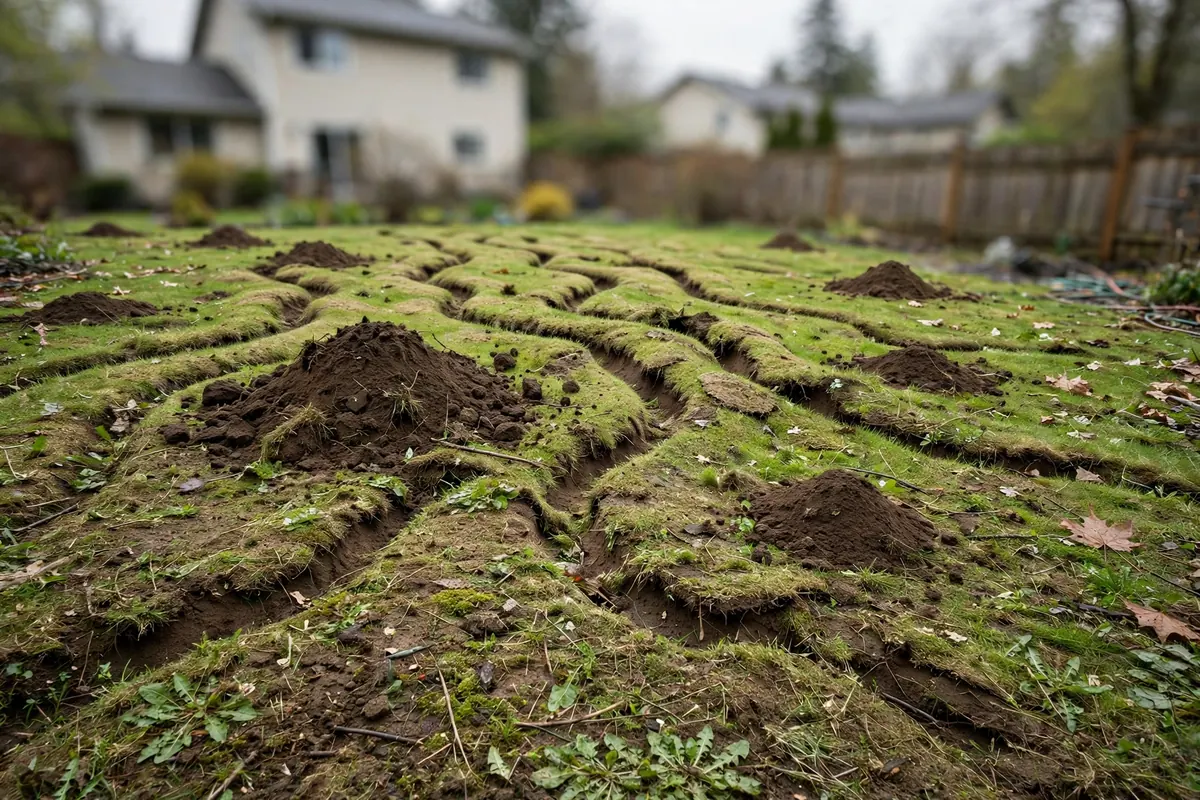
The typical pattern: long-established ridges across the lawn, mounds along fence lines and foundation plantings, and damage that the homeowner describes as "it's been getting worse for years." That's the signature of an entrenched population, not a new invasion. The fix is the same mole control sequence — map, trap, repair, prevent — but expect the mapping phase to take a little longer. Decades-old tunnel systems have more dead ends and abandoned branches to sort through before we find the active runs.
One more City Center note: Seltice Elementary and River City Middle sit in this area, and the surrounding blocks have some of the oldest irrigation infrastructure in town — including older systems that leak. A leaking zone saturates soil continuously, creating a permanent mole magnet regardless of watering schedules. If your mole problem centers on one mysteriously lush area, have the irrigation checked. We've seen "unsolvable" mole problems vanish after a line repair.

Available in Post Falls City Center
Mole Control Services in Post Falls City Center
Mole Control
Complete mole control for Post Falls lawns and gardens — find the tunnels, remove the moles, stop the damage.
Book Mole Control →Mole Trapping
Targeted trapping in active tunnels — the most reliable way to remove moles from lawns and gardens.
Book Mole Trapping →Mole Exclusion
Buried barriers around garden beds and lawns that keep moles from tunneling back in.
Book Mole Exclusion →Dead Mole Removal
Safe pickup and disposal of a dead mole from your yard, garden, or lawn.
Book Dead Mole Removal →Mole Tunnel Repair
Tunnel collapse repair and lawn leveling after mole removal — getting the yard back to mowable shape.
Book Tunnel Repair →Emergency Mole Control
Moles tearing through new sod, a garden, or an irrigation line — call right away.
Book Emergency Mole Control →Central Post Falls — Post Falls, ID
Our Approach in City Center
City Center jobs start with a longer assessment than average. We're reading decades of tunnel history, distinguishing the currently active runs from the archaeological layers. The stomp-and-check test is especially important here — in an old yard, most of the visible ridges are inactive, and trapping the wrong ones wastes weeks.
Working around mature landscaping
We trap with minimal disturbance to established plantings. Below-grade scissor and choker traps, carefully placed, don't require tearing up beds. Where tunnels run through prized garden areas, we discuss whether targeted trapping or a small exclusion barrier makes more sense — sometimes protecting the garden and trapping the lawn is the right split.
The irrigation conversation
Older City Center systems often run on timers set years ago — daily watering, long cycles, regardless of weather. That's the single biggest controllable attractant. We walk through the watering schedule with you: deep, infrequent cycles that keep grass healthy while letting the surface dry. In many City Center yards, this one change does more for long-term prevention than anything else. Combined with exclusion around garden beds where it makes sense, it's the practical package for established properties.
Call (208) 925-9460 — tell us you're in City Center and what you're seeing. We'll talk through whether it sounds like an entrenched population or something newer, and what the next step looks like.
Serving Post Falls City Center
Serving Post Falls, ID 83854 and nearby Kootenai County communities.
Post Falls City Center — FAQs
My City Center yard has had moles for years. Is it too late to fix?
No — but expect it to take a little longer than a new problem. Years of activity means an extensive tunnel network to map, but the process is the same: find the active runs, trap the current moles, repair, prevent. The moles don't know how long they've been there; they just need to be caught.
Will trapping damage my mature landscaping?
No. We use below-grade traps placed in tunnel lines, not excavations through beds. The sets are small and targeted. If tunnels run through a prized garden, we'll discuss whether trapping or a small barrier is the better approach for that specific spot.
Why is the mole damage worst around my big trees?
Mature tree root zones are ideal mole habitat — loose, organic, consistently moist soil full of earthworms. The canopy also moderates summer soil temperatures. Moles concentrate where the digging is easiest and the food is densest, and that's under established trees.
Should I water less to get rid of the moles?
Watering less won't evict an established mole, but it's the most important long-term prevention. Many City Center systems run daily out of habit. Switching to deep, infrequent watering (an inch once or twice a week) keeps grass healthy while making the surface less attractive. It's the change with the biggest payoff.