
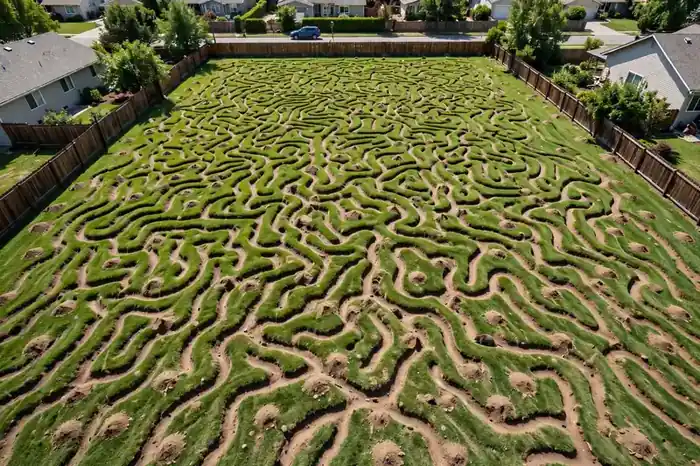
The Twenty-Mound Panic
It usually starts the same way. A homeowner counts the mounds — eight, twelve, twenty — and does the natural math: twenty mounds, twenty moles, hopeless infestation. Then they either give up ("what's the point of trapping one?") or overreact (buying a dozen traps, calling for emergency service, considering drastic measures). Both responses are based on a misunderstanding of how moles use space.
Here's the reality: an extensive tunnel maze is typically one animal's work. Coast moles are solitary and fiercely territorial. A normal density is two to three moles per acre; high density is three to five. A typical suburban Post Falls yard — even one that looks devastated — usually holds exactly one mole. Two at most. That "infestation" is a single animal with an ambitious floor plan.
Why One Mole Makes Such a Mess
A coast mole is active around the clock in roughly four-hour-on, four-hour-off cycles, and it eats 60 to 80 percent of its body weight every single day — nearly all earthworms. Feeding that appetite means constant tunneling. The shallow feeding runs you see as ridges get used once or twice and abandoned; the mole is always pushing into new ground. Over weeks and months, one animal can riddle a surprising area.
Molehills add to the illusion. A single mole can push up around four mounds per day in moist spring soil — and in one documented study, one animal made 302 mounds in 77 days. But mound count is also misleading in the other direction: small mounds often just mark tunnel repairs, while the big impressive ones mark new excavation. Neither count tells you the population. Only trapping tells you that — when catches stop, the territory is empty.
How to Actually Estimate
Forget mound math. The practical estimate comes from the tunnel system's geography. Moles are territorial, and territories don't overlap much — so separate, disconnected tunnel systems suggest separate moles, while one continuous network is one animal. Walk your yard and trace the ridges: do they connect into a single sprawling system, or are there distinct clusters in different areas with undamaged ground between them?
A quarter-acre suburban lot: almost certainly one mole. A half-acre with two distinct damage zones on opposite sides: possibly two. A multi-acre West Prairie property with activity across the whole parcel: could be two or three, plus constant pressure from surrounding open land. These are rules of thumb, not certainties — but they're far more accurate than mound-counting.
The professional version of this assessment is part of every job we do: mapping the active network tells us not just where to trap, but roughly how many animals we're dealing with. And the honest answer we give most Post Falls homeowners is the one they least expect: it's probably just one. Which is good news — one mole is a solvable problem.
What This Means for Control
The one-mole reality changes the strategy in your favor. You don't need a dozen traps — two to four on the verified active runs will intercept an animal that travels its highways two or three times daily. You don't need months of effort — a week or two of active trapping usually clears a single-mole territory. And you don't need to panic about exponential growth, as long as you act before breeding season (January–March) turns one into four.
It also explains the most confusing mole experience: catching one, celebrating, then seeing new mounds two weeks later. That's not the same mole surviving — it's a new one. Moles are territorial, so an emptied territory is prime real estate, especially during the May–June juvenile dispersal when young moles fan out from neighboring yards. The first catch solved the problem; the new mounds are a new problem. Understanding the difference keeps you from concluding that "trapping doesn't work" when it worked exactly as it should.
For the full approach — finding the active tunnels, setting traps correctly, and knowing when the job is done — see our mole trapping guide or call us for an assessment. We'll map your tunnel system and tell you straight how many animals you're likely dealing with. Usually, it's fewer than you fear.
Questions About This Topic
I counted 30 mounds. That can't be one mole, can it?
It very likely is. One mole can make around four mounds per day in moist soil — thirty mounds is roughly a week or two of normal activity. Mound count measures digging effort, not population. Focus on whether the tunnel system is one connected network (one mole) or separate clusters (possibly more).
How do I know when I've caught them all?
When a full week passes with no new mounds, no repaired test sections, and no catches in set traps, the territory is empty. Don't pull traps the day after the first catch — give it the full verification week. Premature trap removal is how 'cleared' yards get recolonized before anyone notices.
If it's usually just one mole, why do I need multiple traps?
Because one mole uses a large network, and a single trap only covers one runway. Two to four traps across the verified active runs means the mole encounters a trap on every trip, rather than having safe alternative routes. More coverage, faster resolution.
Can two moles share a yard?
Occasionally, on larger properties — but they maintain separate territories and avoid each other. What looks like sharing is usually sequential: one mole's territory emptied (trapped, died, or moved on) and another moved in. True simultaneous overlap is rare because they're aggressively territorial.
Need Help With Moles?
Call and describe what you're seeing — we'll talk through the next step.