
What we do
Mole Control Services
Mole Control
Complete mole control for Post Falls lawns and gardens — find the tunnels, remove the moles, stop the damage.
Book Mole Control →Mole Trapping
Targeted trapping in active tunnels — the most reliable way to remove moles from lawns and gardens.
Book Mole Trapping →Mole Exclusion
Buried barriers around garden beds and lawns that keep moles from tunneling back in.
Book Mole Exclusion →Dead Mole Removal
Safe pickup and disposal of a dead mole from your yard, garden, or lawn.
Book Dead Mole Removal →Mole Tunnel Repair
Tunnel collapse repair and lawn leveling after mole removal — getting the yard back to mowable shape.
Book Tunnel Repair →Emergency Mole Control
Moles tearing through new sod, a garden, or an irrigation line — call right away.
Book Emergency Mole Control →Why MoleGuard
Why Choose Us
Right mole, right method
Idaho has exactly one mole species — the coast mole. National franchise pages misidentify it, some even naming the eastern mole. We work on the animal that's actually in your yard.
Trapping-first, because it works
Every university extension service agrees: trapping is the only reliably proven mole control method. No vibration stakes, no miracle granules, no poison promises — just the method research backs.
We read Post Falls ground
Rathdrum Prairie silt loam, irrigation-fed earthworm booms, the dry-summer oasis effect. We diagnose why moles chose your yard, not just where they're digging.
Neighborhood-specific approach
City Center's mature trees, North Prairie's golf-course edge, Milltown's river corridor, West Prairie's farm border, Post Falls East's new construction — each needs different thinking.
Honest about reinvasion
Moles are territorial, so empty tunnels invite the next juvenile — especially during May–June dispersal. We tell you what to expect and how to stay ahead, not just what you want to hear.
How Mole Control Works
Real mole control is trapping, done properly. Every university extension service agrees on this — it's the only method with reliable, repeatable results. Poison baits fail because moles eat earthworms, not grain. Vibrating stakes, castor oil, Juicy Fruit gum, coffee grounds — none of them have held up in testing. What works is finding the active tunnels and setting the right traps in the right places.
- find the active tunnels
Not every ridge on your lawn is worth a trap. Shallow feeding runs get used once or twice and abandoned; the straight, permanent runways are traveled two or three times a day. We flatten short sections of several runs, mark them, and check back in 24 hours. The ones the mole repaired are the active ones — that's where traps go. Straight runs along driveways, sidewalks, and fence lines are the highest-percentage spots.
- set and monitor
We set multiple traps across the active tunnel network — typically two to four for a residential yard — using scissor-jaw or choker traps placed below grade with all light excluded. (See how professional mole trapping works.) Then we check them every couple of days. Idaho requires traps to be checked at least every 72 hours, and we stay well inside that. If a trap hasn't caught in two or three days, it moves — wrong tunnel, wrong spot.
- repair and prevent
Once the moles are out, tunnels collapse and the lawn needs leveling — we flatten ridges, fill and topdress the low spots, and get the yard mowable again. Then prevention: moles are territorial, so an empty tunnel system invites newcomers. We do this work across all Post Falls neighborhoods. Juveniles disperse in May and June from neighboring yards. Sealing the deal means addressing what drew them — usually overwatering — and sometimes a buried barrier around garden beds.
The whole process is timed to Post Falls conditions. Late winter through spring (February to April) is the prime window — trap before the January-to-March breeding season turns one mole into a litter. Fall is the second window. Frozen ground and baked-dry midsummer soil are the slow periods, and we'll tell you honestly if waiting a few weeks makes more sense.
Know your enemy
Moles, by the Numbers
mole species in Idaho — the coast mole. Just one, and we know it well.
of its body weight a mole eats daily — nearly all earthworms, never your plants.
moles per yard, typically. Twenty mounds is usually one busy animal, not an invasion.
gimmicks that beat a well-placed trap. University research is clear on what works.
Why Post Falls Lawns Attract Moles
Post Falls sits on the Rathdrum Prairie, and that geology is half the story. Under the sod there's deep, well-drained silt loam left behind by the Missoula Floods — soil that's easy to dig and holds moisture well. Add a sprinkler system running through a dry Inland Northwest summer, and you've built exactly what a mole wants: soft, damp ground packed with earthworms.
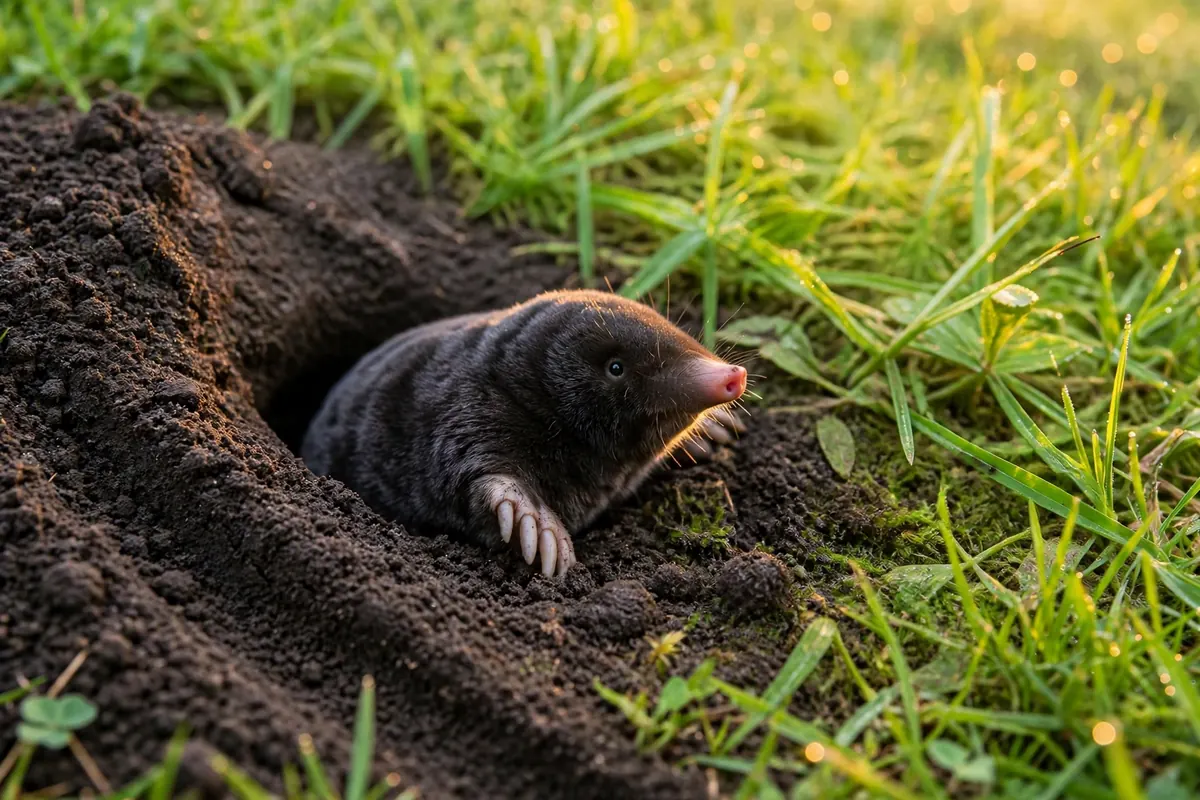
The mole doing the digging is the coast mole, Idaho's only mole species. It's a solitary, territorial animal about the size of a small rat, with broad shovel-like front feet and velvety fur. It doesn't eat your plants — it eats earthworms, 60 to 80 percent of its body weight every single day. An irrigated Post Falls lawn in July is essentially a stocked pantry surrounded by dry, hard ground.
One mole, not an army
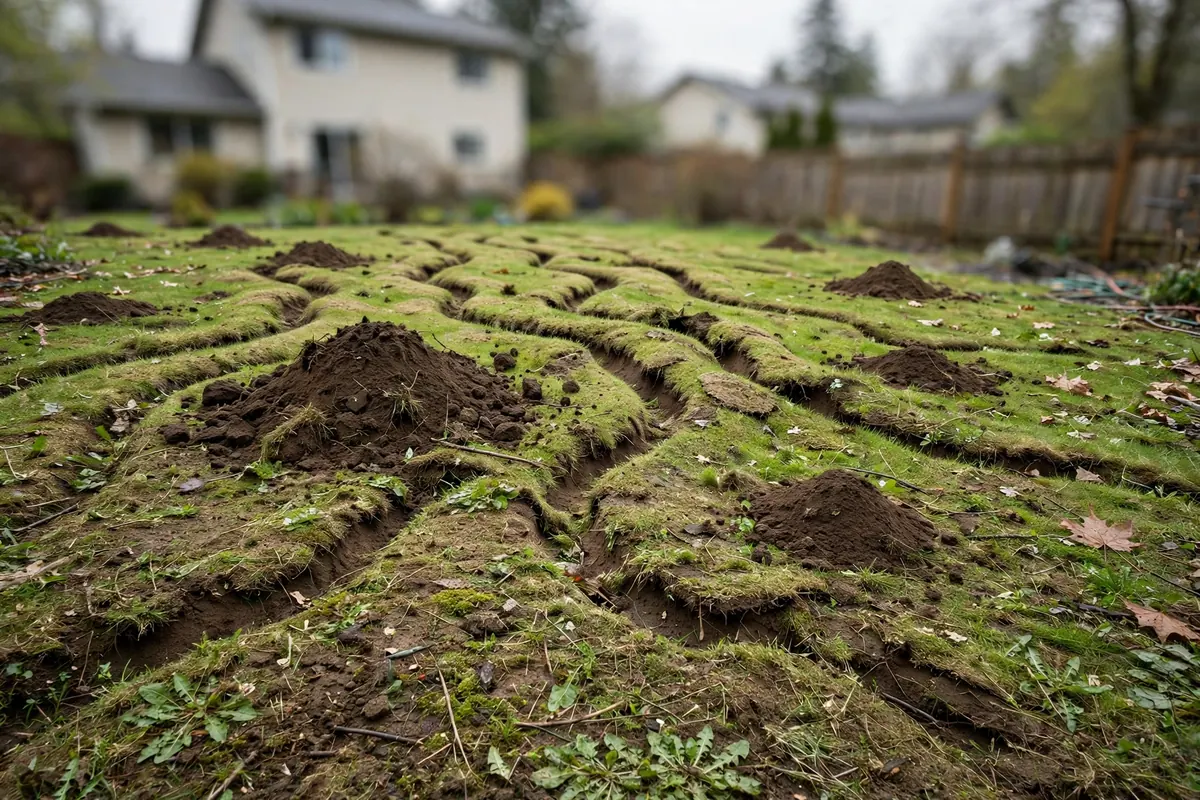
Here's the thing most homeowners get wrong: that maze of tunnels across your yard is usually one animal's work. Coast moles are solitary and territorial — a typical suburban yard holds one, maybe two. Twenty mounds doesn't mean twenty moles. It means one busy mole with an extensive tunnel system, and trapping that single animal often solves the whole problem.
The other common mix-up: voles. Voles travel through old mole tunnels and chew bulbs, roots, and bark. If something ate your tulips, that was almost certainly voles, not the mole — moles are insectivores and don't touch plants. Knowing which animal you're dealing with matters, because the fix is completely different. Our mole control service starts with figuring out exactly what's going on before doing anything else.
Where we work
Areas We Serve
Serving Post Falls, ID 83854 and nearby Kootenai County communities.
Post Falls City Center
Mole control for Post Falls City Center's established homes and mature lawns.
City Center Services →North Prairie
Mole trapping and lawn repair for North Prairie's spacious lots near the golf course.
North Prairie Services →Milltown
Mole control for Milltown homes near the Spokane River — moist riverside soil draws moles.
Milltown Services →West Prairie
Mole control for West Prairie's large lots and open ground bordering farmland.
West Prairie Services →Post Falls East
Mole trapping and exclusion for Post Falls East homes along the Highway 41 corridor.
Post Falls East Services →Common Mole Questions
How do I know if I have moles or voles?
Moles leave raised winding ridges and round volcano-shaped mounds with a centered soil plug — and no open holes. Voles make narrow clipped-grass runways with small open holes, and no mounds. The other tell: moles don't eat plants. If bulbs, roots, or bark are chewed, that's voles.
Will getting rid of grubs get rid of the moles?
No — and this is the most repeated bad advice in lawn care. Moles eat 60 to 80 percent of their body weight daily, mostly earthworms, not grubs. Killing grubs can make moles tunnel more as they search harder.
Why do the moles keep coming back?
Moles are territorial — remove one and the empty tunnels attract the next juvenile. May–June dispersal sends young moles out from neighboring yards, and if the attractant (usually an overwatered, worm-rich lawn) hasn't changed, there's no reason for the next mole to stay away. Lasting control means removing the current moles AND addressing reinvasion.
When is the best time to deal with moles in Post Falls?
Late winter through spring (February to April) and fall (September to October). Trap before the January-to-March breeding season. Spring thaw is prime — workable ground, active moles. Frozen winter ground and dry midsummer are the slow periods.
Is it legal to trap moles in Idaho?
Yes. Moles are unprotected wildlife in Idaho — no season, no bag limit. Idaho Code § 36-1107 also lets property owners trap animals damaging their property. Traps must be checked at least every 72 hours under state rules.
Seeing Fresh Molehills?
Call and tell us what you're seeing — we'll talk through what to do next.