
Idaho Has Exactly One Mole Species
If you search for mole information online, you'll quickly encounter confident claims about which species is tearing up your lawn. One major pest control company's Idaho page says it's the eastern mole. Pest guides written for the East Coast describe eastern mole behavior as if it applies everywhere. Here's the problem: the eastern mole doesn't occur west of the Rockies. Not in Idaho, not in Post Falls, not anywhere near you.
Idaho has exactly one mole species: the coast mole (Scapanus orarius). It's confirmed on the Idaho mammal list and the BLM's special-status species list for the Coeur d'Alene district. The Townsend's mole — a larger cousin you might read about — lives along the Pacific coast from British Columbia to California and doesn't extend into Idaho. When a website tells you about "Townsend's moles in Idaho" or blames the eastern mole, it's working from the wrong animal.
Does the species actually matter for getting rid of them? More than you'd think. Different species have different breeding seasons, different activity patterns, and different sizes — all of which affect when and how trapping works. Advice calibrated for eastern moles in Ohio doesn't map cleanly onto coast moles in North Idaho. The fundamentals transfer (they're all solitary, territorial insectivores), but the details that determine timing and technique are local — which is why our mole control process is built around the animal that's actually here.
Meet the Coast Mole
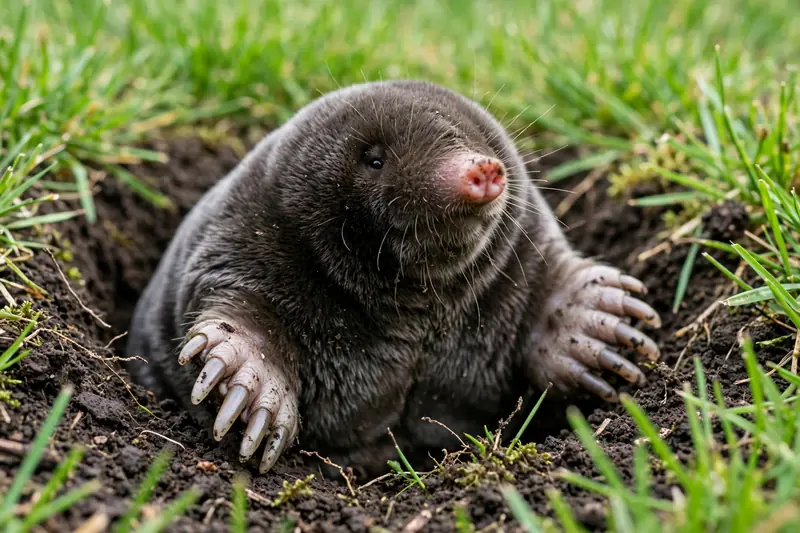
The coast mole is a compact, powerfully built animal — smaller than its Townsend's cousin, roughly the size of a large mouse but much heavier for its length, with dense velvety fur that lies in any direction (so it can back up through tunnels without snagging) and those unmistakable broad front feet turned outward like living shovels.
It lives the way all moles do: mostly underground, in a tunnel system with two distinct parts. Shallow feeding runs, just a few inches deep, show as the raised ridges on your lawn — these get used once or twice and abandoned. Deeper permanent runways, straighter and traveled daily, are the mole's highways. The round volcano-shaped mounds with a centered soil plug are excavated dirt pushed up from below.
Coast moles don't hibernate. They're active year-round in roughly four-hour-on, four-hour-off cycles, digging hardest in fall and winter when the soil is moist. In Post Falls, that means the damage you notice in spring was often dug months earlier under the snow — and the fall surge is the real action. They eat 60 to 80 percent of their body weight daily, nearly all earthworms. They do not eat your plants. Ever. If something ate your bulbs, keep reading — that's a different animal. (Our mole vs. vole guide walks through the full identification.)
Why Everyone Gets This Wrong
The species confusion isn't random — it follows the money in content production. National pest control companies write one mole page and deploy it across hundreds of city subdomains. The writers (or templates) default to the eastern mole because it's the most familiar species nationally. Nobody checks whether it occurs in Idaho. The result: a Post Falls homeowner reads authoritative-sounding advice about an animal that has never set foot — er, shovel-foot — in the state.
The DIY blogs are worse in a different way. Most are written for eastern and midwestern audiences, and their core recommendations reflect that. The classic example: "kill the grubs and the moles will leave." That advice assumes a diet where grubs matter. For western moles eating 70 to 90 percent earthworms, grub control is nearly irrelevant — and can make tunneling worse as moles search harder for the worms that remain. The #1-ranked advice on the internet is regionally wrong for Post Falls.
This is also why local expertise matters more for moles than for most pests. Ants are ants everywhere. But mole control done right depends on species behavior, local soil, local timing — the things national templates can't provide. When you're choosing who to call, the company that knows which mole you actually have is the one more likely to get the trapping right too.
Questions About This Topic
So which mole do I actually have in Post Falls?
The coast mole (Scapanus orarius) — it's Idaho's only mole species. Not the eastern mole (doesn't occur west of the Rockies), not Townsend's mole (Pacific coast only). For practical purposes, though, what matters most is that it's a solitary, territorial, earthworm-eating tunneling mole — and the control approach is the same regardless of which Scapanus species you're dealing with.
Does the species change how I should deal with them?
The fundamentals don't change: trapping in active tunnels is the proven method for all North American moles — see our mole trapping page for how it's done right. What changes is timing and expectations — breeding seasons, activity peaks, and tunnel architecture vary by species and region. That's why Idaho-specific timing (late winter through spring, and fall) beats generic national advice.
Could it be gophers instead of moles?
Pocket gophers don't occur in this part of Idaho, so in Post Falls it's essentially moles or voles. Moles make raised ridges and round volcano mounds with centered plugs and no open holes. Voles make surface runways with no mounds and chew plants. Different animals, different fixes — and moles get blamed for vole damage constantly.
Need Help With Moles?
Call and describe what you're seeing — we'll talk through the next step.