
The Most Common Misidentification in Lawn Care
Here's something the pest control industry doesn't advertise: a large share of "mole" complaints aren't moles at all. They're voles — small mouse-like rodents that travel through old mole tunnels, clip grass into surface runways, and chew bulbs, roots, and bark. The homeowner sees tunnel damage, assumes moles, and either buys the wrong product or calls about the wrong animal. Then the "mole treatment" fails, because there was never a mole problem to solve.
The confusion is understandable. Voles and moles both tunnel. Both are active in the same lawns. And voles genuinely do use abandoned mole tunnels as ready-made highways, so the two animals' sign often appears in exactly the same yard — sometimes at the same time. But they are completely different animals requiring completely different responses, and telling them apart takes about thirty seconds once you know what to look at.
The Visual Test: Mounds, Ridges, and Runways
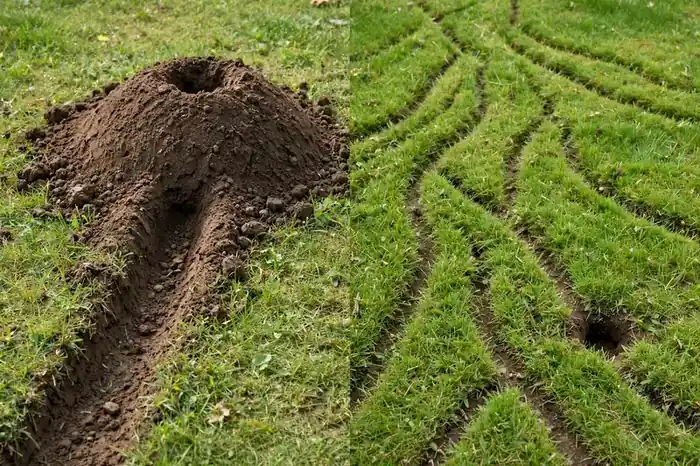
Moles make two unmistakable signs. First, raised winding ridges — the shallow feeding tunnels pushing up the turf surface, meandering with no clear pattern. Second, round volcano-shaped mounds with a centered soil plug, where excavated dirt was pushed straight up from below. Critically: no open holes. A mole's tunnel system has no visible entrances — everything is sealed. If you see a hole you can look into, it's not an active mole tunnel.
Voles make narrow surface runways — clipped-grass paths about one to two inches wide, winding across the lawn surface, often with small open holes along the way. No mounds. No raised ridges. Just those distinctive runways, most visible in spring after snowmelt (which is why so many "mole explosions" reported in April are actually vole damage revealed by melting snow).
The pocket gopher, for completeness, makes fan- or crescent-shaped mounds with an off-center plugged hole — but pocket gophers don't occur in this part of Idaho, so in Post Falls your decision is moles versus voles, full stop.
The Damage Test: Who Ate What
This is the decisive test, and it's absolute: moles do not eat plants. Not bulbs, not roots, not bark, not vegetables. They are insectivores — 70 to 90 percent earthworms. If something chewed your tulip bulbs, girdled your young trees, or ate the roots off your perennials, that was voles. Period. No exceptions, no edge cases.
Mole damage is purely mechanical: root disturbance from tunneling, ridges that dry out and brown, mounds that smother grass, collapsed tunnels that leave the lawn uneven and spongy. The plants aren't eaten; their roots are undermined. It's an important distinction because it changes both the urgency (voles actively destroy plantings; moles disrupt the lawn surface) and the solution.
The cruel twist: voles traveling through old mole tunnels get the moles blamed for their damage. A yard with both shows mole ridges AND chewed plants, and the homeowner reasonably — but wrongly — attributes everything to the mole. We've seen people trap diligently for moles while voles continued the actual plant destruction untouched.
Different Animals, Different Fixes
For moles: trapping in active tunnels is the proven method. Identify the active runs (see our stomp-and-check guide), set scissor or choker traps, check every few days. Our mole trapping page covers the professional approach in detail.
For voles: a different playbook entirely. Snap traps baited with peanut butter or apple placed perpendicular to runways. Habitat reduction — voles love cover, so clearing mulch, dense groundcover, and debris near vulnerable plantings helps enormously. Tree guards (hardware cloth cylinders) for young trees. Some homeowners have success with encouraging raptors (owl boxes, perches) — voles are prime hawk and owl food.
For both: start with correct identification, because every wrong-ID treatment is money and time spent on the wrong animal. When in doubt, photograph the sign — wide shots of the pattern plus close-ups of mounds or runways — and call us. We read sign for a living, and we'll tell you straight which animal you're dealing with before anyone sets a trap or spends a dollar.
Questions About This Topic
Can I have both moles AND voles at the same time?
Yes — and it's common. Voles move into abandoned mole tunnels, so a yard with an old mole network is pre-furnished vole housing. If you see both ridges/mounds AND chewed plants, you're likely dealing with both animals, and they need different approaches.
Something ate all my tulip bulbs underground. Mole or vole?
Vole, almost certainly. Moles don't eat bulbs, roots, or any plant material — they're insectivores. Underground bulb damage with no surface mounds is textbook vole. (Though the voles may well have reached your bulbs via old mole tunnels.)
Why do I only see the vole damage in spring?
Vole runways are most visible after snowmelt — the snow protected their winter surface activity, and melting reveals the full network at once. It looks like sudden devastation, but it accumulated over months. This is also why so many spring 'mole explosions' are misdiagnosed.
If I get rid of the moles, will the voles leave too?
No — and this surprises people. Removing moles doesn't remove voles; if anything, the empty tunnels become even more available as vole highways. Vole control (trapping, habitat reduction, tree guards) is a separate job with separate methods.
Need Help With Moles?
Call and describe what you're seeing — we'll talk through the next step.