

MoleGuard — Tunnel Trapping
Trapping: The Method That Actually Works
Ask any university extension service — Washington State, Kansas State, Missouri, Cornell — and you'll get the same answer: trapping is the single most reliable way to remove moles. Not the only method ever tried, but the only one with consistent, repeatable results backed by research. Everything else is either unproven, temporary, or wishful thinking with good marketing.
The reason is straightforward. Moles eat earthworms — 60 to 80 percent of their body weight every day, nearly all worms. Poison grain baits fail because moles don't eat grain. Repellents fail because a hungry mole habituates or just tunnels around the treated spot. But a well-placed trap in an active tunnel intercepts an animal that travels that runway two or three times a day. It's not clever. It's just geometry.
Trapping: The Method That Actually Works: Key Details
- The traps we use
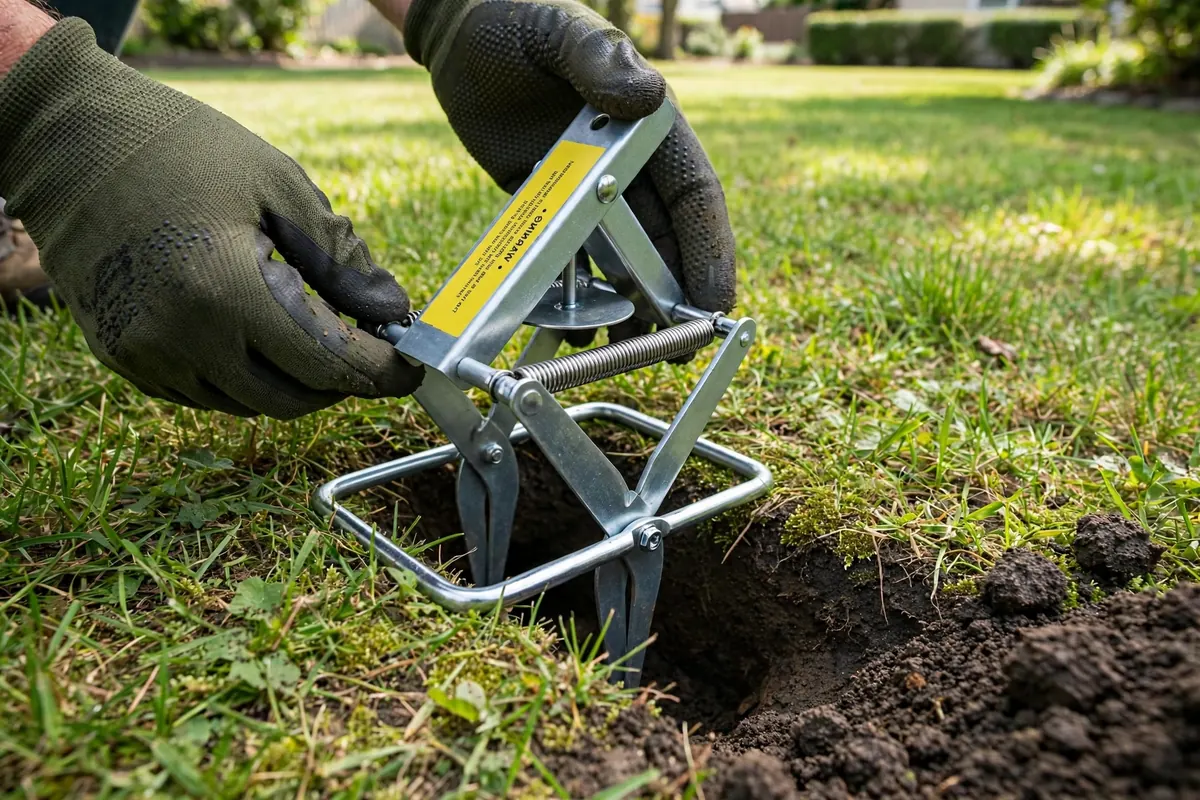
Scissor-jaw traps (like the Victor Out-of-Sight) are the workhorse. Two spring-loaded jaw pairs straddle the tunnel; when the mole passes and trips the trigger, the jaws snap shut. Placement is everything: we cut an excavation across the tunnel, set the trap in line, pack damp soil under the trigger pan, and exclude every bit of light. The classic DIY failure is digging the hole too wide — the mole just detours around the trap.
Choker or loop traps (like the Nash) encircle the tunnel with a wire loop that tightens when triggered. They're often the most forgiving for tricky soil conditions. Harpoon or spear traps drive spikes downward when the mole pushes soil against the trigger pan — effective, but they sit above ground, so we avoid them where kids or pets play.
- Placement is the whole game
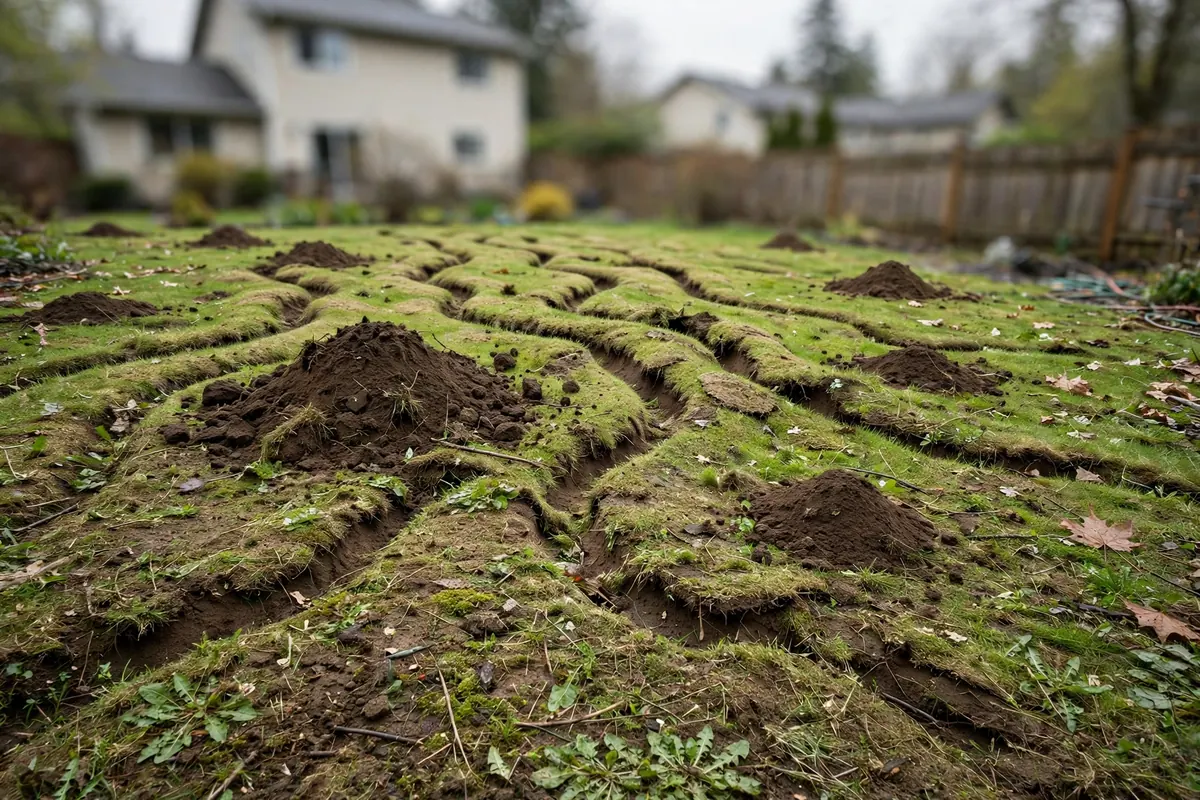
Here's where most DIY trapping fails: the traps go on the wrong tunnels. Those twisty surface ridges all over the lawn? Feeding runs, used once or twice and abandoned. Setting traps there is like fishing in a swimming pool. The permanent runways — straighter, deeper, traveled daily — are where catches happen.
We find them with the stomp-and-check method: flatten two-to-three-inch sections of several runs, mark the spots with flags, and check in 24 hours. Repaired sections are active. Straight runs along driveways, sidewalks, and foundations are consistently the best bets — moles use hard edges as navigational highways. Our blog has the full walkthrough with photos if you want to try the test yourself before calling.
Dealing With Mole Trapping?
Call MoleGuard — tell us what you're seeing and we'll take it from there.
MoleGuard — Tunnel Trapping
What a Professional Trapping Visit Looks Like
First visit: we walk the yard reading sign — mound patterns, ridge layouts, soil conditions — and run the activity test on the most promising runs. Then we set two to four traps across the verified active network. The whole thing usually takes under an hour for a typical residential yard.
Then we come back every two to three days. Idaho requires traps to be checked at least every 72 hours; we check more often because a sprung-empty trap is a trap that's not catching. Each check, we note what's been caught, reset or relocate traps that haven't fired, and read the fresh sign. A trap sitting quiet for two or three days moves to a new tunnel — it's on dead ground.

What a Professional Trapping Visit Looks Like: Key Details
- How long until they're gone?
On a truly active run, expect a catch every 24 to 48 hours until that tunnel's moles are gone. Most Post Falls yards hold one or two moles, so a week or two of active trapping usually clears the territory. When a full week passes with no new mounds and no catches, the job is done.
What slows things down: trap-shy moles that have encountered badly set DIY traps before (they learn), misread sign putting traps on inactive runs, and — the big one — reinvasion. A yard backing onto open space can see new moles arrive within weeks of clearing. That's not failure; it's biology. It just means the conversation shifts from removal to ongoing management.
- Why DIY trapping usually disappoints
We see the same six mistakes: wrong tunnel selection (feeding runs instead of travelways, never verifying activity), too few traps for the network size, bad set mechanics (wide holes, light leaks, insensitive triggers), impatience (moving traps after one quiet day, or giving up entirely), mistaken census (one mole's network looks like ten moles' work), and ignoring reinvasion. Any one of these turns a solvable problem into months of frustration. If you've already tried and failed, the tunnels are still there — and now we know which ones the mole actually uses, because it told us by avoiding your traps.
One more honest note: trapping works best February through April and September through October in North Idaho. Frozen ground (December–February) and baked-dry midsummer soil aren't trap-friendly. If you call mid-winter, we'll say so rather than sell you a visit that can't succeed yet.
Mole Trapping — FAQs
How many traps do you set?
Typically two to four for a residential yard, spread across the verified active tunnel network. More tunnels than traps means the mole has options; the goal is covering the high-traffic runways so every trip risks an encounter. Larger properties or heavy infestations may need more.
How often do you check the traps?
Every two to three days. Idaho law requires trap checks at least every 72 hours, and we stay well inside that — a sprung or full trap isn't catching anything, so frequent checks keep the operation effective.
Are the traps dangerous to my pets or children?
We use below-grade scissor and choker traps set in line with the tunnel and covered so no light escapes — nothing exposed on the surface. We avoid above-ground harpoon traps in yards with kids or pets. As with any trapping, we ask that children and pets be kept away from flagged trap locations during the service period.
I've tried trapping myself and caught nothing. Why would yours work?
The usual reasons DIY fails: traps on inactive feeding runs instead of daily travelways, holes dug too wide (moles detour around), light leaking into the set, triggers set too stiff or too loose, and giving up too soon. Professional trapping is mostly about tunnel reading and set mechanics — the trap itself is the easy part.
Do you relocate the moles alive?
Idaho generally requires a permit to relocate wildlife, with narrow exceptions. We don't advertise live-trap-and-relocate because the legal path is murky and relocated moles often don't survive the move — they're intensely territorial and dumped into another mole's territory. Lethal trapping is the standard, effective, and legal approach.
What happens to the tunnels after the moles are gone?
Empty tunnels collapse over time, leaving sunken ridges and uneven ground. That's a separate job — see our mole tunnel repair page. We flatten, fill, and level as part of the full control sequence so your yard is mowable again, not just mole-free.