
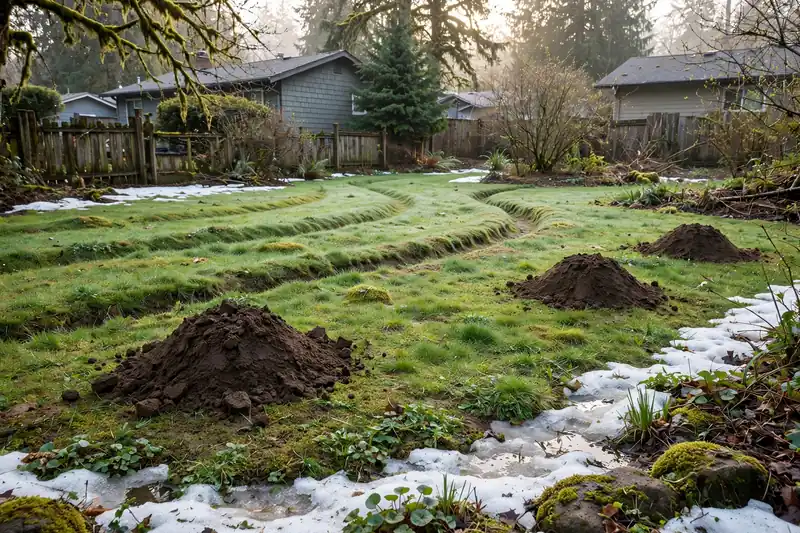
Why Timing Matters More Here
Most mole advice on the internet assumes a generic temperate climate — mild winters, no frozen ground, year-round surface activity. Post Falls doesn't work that way. Ground freezes solid from roughly December through February. Summers bake dry in July and August. Those two extremes reshape the entire mole year, and acting on the wrong schedule wastes time and money.
The coast mole doesn't hibernate — it's active underground all year in roughly four-hour cycles. But "active" and "catchable" aren't the same thing. When the ground is frozen or baked hard, moles work deep, below the frost line or the dry crust. No surface runs, nothing to trap, nothing to read. The calendar below is built around when moles are accessible near the surface in Kootenai County conditions — which is the only thing that matters for control.
January – March: The Breeding Window
January–February: Deep winter. Ground frozen, minimal surface activity. This is the planning window, not the action window — with one critical exception noted below. Use this time to read up, check your irrigation timer (it's probably still on a summer schedule), and line up service for spring.
March: The thaw begins, and with it the most important biological deadline of the year. Coast moles mate January through March; litters of three to four are born March to April. A single mole trapped in February is one animal. That same mole in late April is a mother with young. Every mole removed before breeding season prevents three to four more. As soon as the ground is workable — usually mid to late March in Post Falls — trapping season opens, and early action has the highest leverage of the entire year.
April – June: Prime Time (and the Dispersal Wave)
April: Prime trapping season. Thawed ground, moles working near the surface, pre- and early-breeding. This is when professional trapping is most efficient — active runs are easy to read, soil is workable, and every catch prevents exponential growth. If you do one thing all year, trap in April.
May–June: Still good trapping, but now with a complication: juvenile dispersal. Young moles leave the nest in May and fan out looking for territory — most traveling under 1,000 feet from where they were born. Your neighbor's yard is the source; your yard is the destination. New mounds appearing in May don't necessarily mean the spring trapping failed — they may mean the next generation has arrived. This is also when reinvasion pressure peaks near open space, river corridors, and farmland edges.
July – August: The Quiet Months
Post Falls summers are dry — very little rain, highs in the 80s — and the top inches of unirrigated soil bake hard. Moles respond by going deep, below the dry crust, where the soil stays workable and worms retreat. Surface activity drops dramatically. The mole is still there; it's just not catchable near the surface.
What to do: irrigation management. This is the season when watering habits matter most. A lawn soaked daily keeps the surface moist, worm-rich, and tunnel-friendly straight through the dry months — essentially air-conditioning the mole's habitat. Deep, infrequent watering (an inch once or twice a week, early morning) keeps grass healthy while letting the surface dry between cycles. You're not trying to kill worms; you're making the top few inches less of a 24-hour buffet. It's also the right time to plan fall trapping and, for new construction, schedule under-sod exclusion before autumn projects.
September – October: The Second Window
Fall is the year's second prime trapping window, and in some ways the most productive. Moles dig intensively in moist autumn soil, building food reserves and expanding tunnel systems before winter. The runs are heavily traveled, easy to read, and trap-friendly. September and October catches remove the animals that would otherwise breed come January — it's the bookend to spring trapping, and together the two windows cover the full annual cycle.
Fall is also lawn-repair season. Tunnel damage from the year's activity gets flattened, topdressed, and overseeded in September — the ideal seeding window for North Idaho, with warm soil, cool air, and autumn rain on the way. Repair in fall, and the lawn goes into winter level and recovering instead of lumpy and thin.
November – December: Wind Down
Surface activity tapers as soil temperatures drop. Late November into December, the ground starts freezing and the year's trapping window closes. What to do: final lawn assessment (any unrepaired damage gets flagged for spring), irrigation winterization (drain the system — and note that a properly winterized system isn't attracting anything), and planning. If this was a bad mole year, November is the time to book early-spring service rather than waiting until the mounds appear in April.
The annual rhythm, in short: trap in spring (before breeding) and fall (before winter), manage water in summer, plan in winter. Work with the mole's calendar instead of against it, and control gets dramatically easier. Work against it — trapping frozen ground, ignoring the breeding window, overwatering through August — and you're fighting biology with one hand tied.
For help timing your specific situation, call MoleGuard — we'll tell you honestly whether now is the right moment or whether waiting a few weeks gets better results. Our mole control process follows this calendar on every job.
Questions About This Topic
When is the absolute best month to trap moles in Post Falls?
April — thawed ground, active surface tunneling, and pre-breeding timing. March is excellent if the ground is workable. September–October is the strong second window. The key insight: trap before the January–March breeding season produces litters, so late winter through spring has the highest leverage.
Should I do anything about moles in winter?
Not trapping — frozen ground makes it impractical. But winter is ideal for planning: review your irrigation schedule, book spring service early, and note where the damage was worst last fall so you know where to start. Spring snowmelt will reveal winter tunneling; don't mistake it for new activity.
Why are there suddenly mounds in May when we had none in April?
Juvenile dispersal. Young moles leave the nest in May and fan out — most under 1,000 feet from birth. Your neighbor's yard, the nearby park, or the river corridor sent you new tenants. It's not a trapping failure; it's the annual wave. Catch them now before they establish.
Does the calendar change if I'm near the river or farmland?
The windows don't change, but the pressure does. River corridors and agricultural edges supply constant reinvasion, so the May–June wave hits harder and fall trapping matters more. Properties in these spots — like Milltown along the Spokane River or West Prairie near farmland — benefit from thinking in terms of ongoing seasonal management rather than one-time fixes. See all areas we serve.
Need Help With Moles?
Call and describe what you're seeing — we'll talk through the next step.