
The Advice Everyone Repeats
"Get rid of the grubs and the moles will leave." You've heard it from neighbors, from garden center staff, maybe from a pest control company. It's the centerpiece of major DIY articles — one prominent home-improvement site builds its entire mole guide around it. It sounds logical: moles eat grubs, so no grubs means no moles. The logic is clean. It's also wrong — at least for the moles in your Post Falls yard.
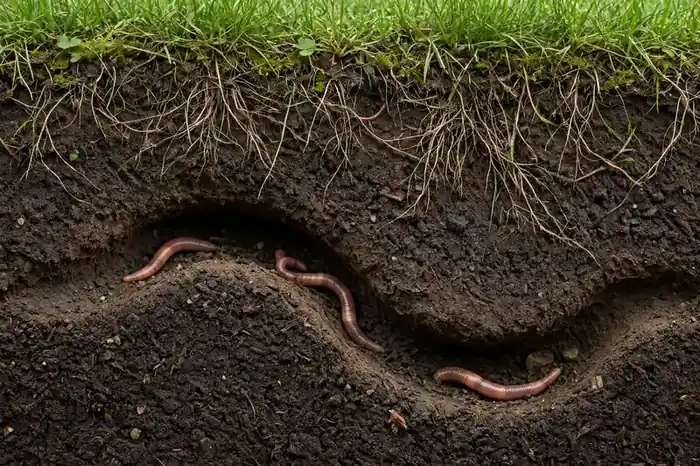
Here's the actual diet of the coast mole, Idaho's only mole species: 70 to 90 percent earthworms. Not grubs — earthworms. A mole eats 60 to 80 percent of its body weight every single day, and nearly all of it is worms pulled from the soil of your irrigated lawn. Grubs are, at best, a side dish. Removing the side dish doesn't close the restaurant.
What the Research Says
Washington State University's extension service — the authority for our region — is explicit: moles frequent well-irrigated lawns even when they're grub-free. The worms are the draw, and no grub product touches the worm population. This isn't a debated point in the research; it's settled. The confusion comes from eastern-mole-centric content written for regions where the dietary mix may differ, then applied nationally without qualification.
Worse, grub control can backfire. When you kill the grubs, the mole doesn't leave — it tunnels more aggressively searching for the earthworms that remain, expanding its network through your lawn in the process. Homeowners who apply grub killer and then see increased tunneling assume the product "stirred them up." What's actually happening is a hungry mole working harder in the same territory. You've spent money to make the problem more visible.
Why This Myth Persists
Three reasons. First, it's intuitive — the food-chain logic feels right even though the proportions are wrong. Second, it's profitable: grub control products are a multi-million-dollar category, and "also repels moles" is a compelling secondary claim that moves product. Third, confirmation bias does the rest. Someone applies grub killer in October, the moles go quiet for winter (as they always do when soil cools), and the product gets the credit for seasonal biology.
The timing illusion is the sneakiest part. Grub treatments go down in late summer and fall — exactly when mole surface activity naturally declines as soils cool and then freeze. Come spring, if the moles return, the homeowner assumes they need another application. If they don't return (because the territory's mole died or moved), the product gets credit. Either way, the grub killer wins and the homeowner learns nothing about actual mole control.
What Actually Removes Moles
Trapping. Every university extension service — WSU, Kansas State, Missouri, Cornell, UC — lands in the same place: trapping in active tunnels is the only reliably effective mole control. Not the only method ever attempted, but the only one with consistent results. It works because it intercepts the animal directly, regardless of what it's eating.
The honest hierarchy, from most to least effective: (1) trapping in verified active tunnels; (2) exclusion barriers for defined areas; (3) habitat modification, mainly irrigation adjustment to make the surface less worm-dense; (4) everything else — repellents, vibration stakes, castor oil, grub control — unproven, temporary, or counterproductive. If someone's selling you a solution that isn't in the top three, ask what evidence it's based on. Then check whether that evidence was gathered on your species, in your region. It usually wasn't.
For the full picture of what works and why, see our mole control process — or read about finding active tunnels if you want to understand the trapping approach before calling. And if you've already bought the grub killer: use it for the grubs (it's fine for that). Just don't expect the moles to notice.
Questions About This Topic
I already applied grub killer. Did I waste my money?
For the grubs, no — it does what it says. For the moles, yes, unfortunately. The moles are there for earthworms, which the product doesn't affect. Don't apply more expecting a different result; put that budget toward trapping, which actually removes moles.
But my neighbor swears grub control fixed their mole problem. How?
Almost certainly coincidence dressed as causation. Grub treatments go down in late summer/fall, right when mole surface activity naturally declines with cooling soil. The moles went quiet for winter; the product got the credit. Or the territory's mole died or relocated for unrelated reasons. Correlation, not causation.
Are there ANY situations where grub control helps with moles?
Marginally, in lawns where grubs are genuinely abundant AND earthworms are scarce — an unusual combination in irrigated Post Falls lawns. Even then, it's a minor factor, not a solution. The extension services don't list it as a control method for a reason.
So what should I do instead?
Trap the active tunnels — it's the only method with reliable results. Then address the real attractant: usually overwatering keeping the surface worm-dense. Our mole trapping page explains the professional approach, and the seasonal calendar in our North Idaho guide tells you when to act.
Need Help With Moles?
Call and describe what you're seeing — we'll talk through the next step.