
Why Mole Myths Thrive
Mole control has one of the worst signal-to-noise ratios in all of home pest advice. For every evidence-based recommendation (trapping), there are a dozen folk remedies with passionate advocates and zero scientific support. The myths persist because moles are frustrating, the real solution requires effort, and every spring a new crop of desperate homeowners meets an internet full of confident nonsense.
What follows isn't opinion — it's what university extension services (Kansas State, Missouri, UC, Washington State) and published research actually found when they tested these methods. Some are merely useless. A couple are illegal. One can make the problem worse.
Myth 1: Vibrating / Ultrasonic Stakes Work
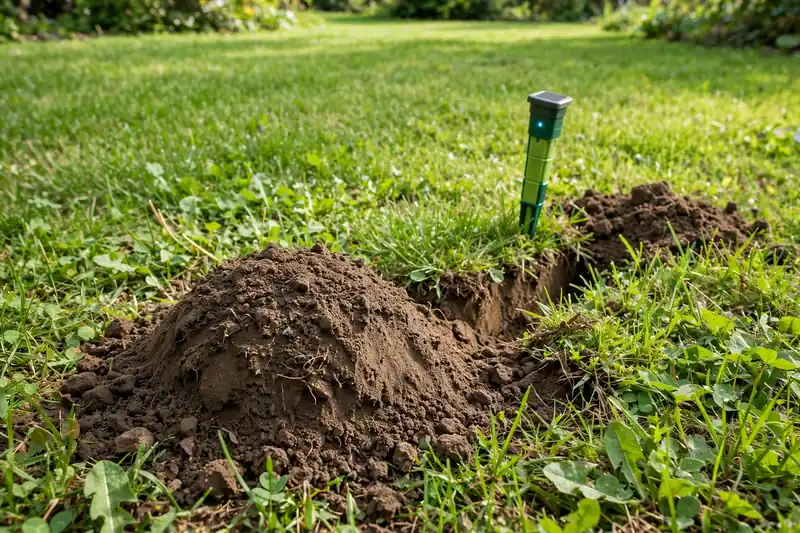
Verdict: No. The theory is that vibration drives moles away. The evidence: none in peer-reviewed research. UC's Integrated Pest Management program and the University of Nebraska both found no solid support, and the FTC has pushed manufacturers to drop their efficacy claims. What actually happens: moles habituate within days. The stake buzzes; the mole tunnels around it. You're out $30–$60 per stake and the mounds keep coming.
Myth 2: Juicy Fruit Gum Kills Moles
Verdict: No. The theory is that moles eat the gum and it blocks their digestion. The problem: moles are insectivores. They eat earthworms, not chewing gum, and they show zero interest in it. Kansas State and the Missouri Department of Conservation both address this one specifically — no studies support it, because there's no mechanism by which it could work. This myth has survived decades on pure anecdote.
Myth 3: Castor Oil Repels Moles
Verdict: Limited at best, and temporary. This is the most credible of the repellents, which isn't saying much. One small trial in the mid-1990s showed 30 to 65 days of reduced tunneling activity. But the University of Kentucky found no dose response (more product didn't work better), and Iowa State calls the results "inconsistent." At most, castor oil might reduce tunneling for a few weeks. It does not remove the mole. And at the application rates and prices involved, you're buying weeks of maybe.
Myth 4: Coffee Grounds Deter Moles
Verdict: No. This one rode in on the composting trend — coffee grounds are great for gardens, so surely they repel moles? The University of California tested it specifically. Zero effect on mole behavior. Your garden gets the nitrogen benefit; the mole doesn't notice.
Myth 5: Mothballs Drive Them Away
Verdict: No — and illegal. Mothballs are a registered pesticide, and using them off-label (i.e., anywhere other than in a sealed container for clothes moths, as the label directs) violates federal law under FIFRA. They're also toxic to children and pets, and the vapors dissipate almost immediately outdoors. Ineffective, illegal, and dangerous: the trifecta. Never use mothballs in the yard for any reason.
Myth 6: Flooding the Tunnels Drowns Them
Verdict: Rarely, and risky. The theory is sound in miniature: flood the tunnels, the mole drowns or leaves. In practice, mole tunnel systems are extensive — far beyond what a garden hose can fill — and moles seal off flooded sections in seconds. It only has any chance against a brand-new invader with a tiny system, flooded all at once. And never near foundations, where you're trading a mole problem for a water problem.
Myth 7: Killing Grubs Gets Rid of Moles
Verdict: No — and it can backfire. This deserves its own post (we wrote one: why grub control won't evict your moles), but the short version: moles eat 70–90% earthworms, not grubs. Killing grubs doesn't remove the food source, and hungry moles tunnel more aggressively searching for the worms that remain. You've paid to make the problem more visible.
What Actually Works
After seven myths, the honest answer is almost anticlimactic: trapping in active tunnels. It's the only method every university extension agrees on, the only one with consistent results, and the core of our professional trapping service. Find the active runs (our stomp-and-check guide shows how), set the right traps correctly, check every few days. It's work — but it's work that ends with the moles gone, instead of money spent on the geological equivalent of wishful thinking.
For new lawns and garden beds, buried exclusion barriers are the legitimate long-term play. For everything else on this list: save your money, skip the garden-center repellent aisle, and call someone who traps.
Questions About This Topic
Are there ANY repellents worth trying?
Honestly? No, not as a primary strategy. Castor oil has the most evidence of anything in this category, and that evidence is one small 1990s trial showing weeks of reduced activity — not removal. Everything else (vibration, ultrasonic, granular 'repellents') has no meaningful support. Put the repellent budget toward trapping.
Why do so many people swear these methods worked for them?
Three reasons: seasonal timing (moles go quiet in winter regardless — the product gets credit for biology), coincidence (the mole died, moved, or was trapped by a neighbor), and the human tendency to remember hits and forget misses. Controlled testing strips all of that away, and what's left is: trapping works, the rest doesn't.
Is it true that moles are good for the soil and should be left alone?
There's a grain of truth — tunneling aerates soil and mixes organic matter. But 'good for the soil' and 'good for your lawn' aren't the same thing. One mole's aeration comes with destroyed turf, collapsed ridges, and dead patches. In a meadow, fine. In your yard, it's damage. Tolerance is a valid personal choice, but it's not an ecological imperative.
What's the single biggest waste of money in mole control?
The repellent category as a whole — vibration stakes, ultrasonic spikes, granular repellents, and the various home remedies. Collectively they represent far more spending than professional trapping, with a fraction of a percent of the results. If you've already bought them, consider it tuition.
Need Help With Moles?
Call and describe what you're seeing — we'll talk through the next step.